
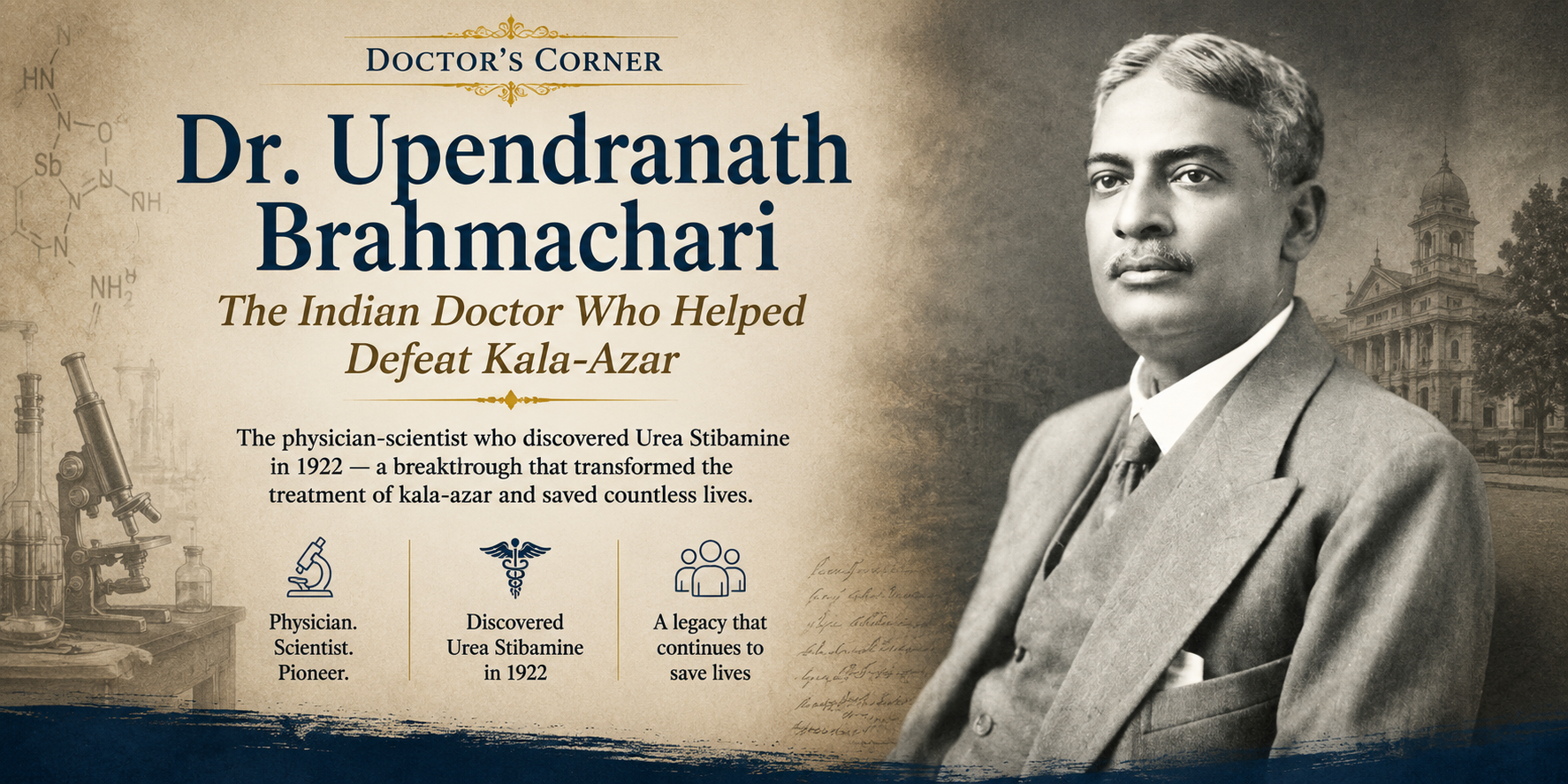
Some doctors are remembered for treating patients. Some are remembered because they changed the course of the disease itself.
Dr. Upendranath Brahmachari belongs to the second kind.
Born in 1873 in Bengal, Dr. Brahmachari became one of India’s most important physician-scientists. At a time when kala-azar, also known as visceral leishmaniasis, was taking countless lives, he dedicated himself to finding a more effective treatment. In 1922, he discovered Urea Stibamine, a drug that transformed the treatment of kala-azar and helped save many lives. (PMC)
Kala-azar was once one of India’s most feared tropical diseases. It causes prolonged fever, severe weakness, anemia, enlargement of the spleen and liver, and, if untreated, often death. Its impact was especially cruel because it affected poor communities where delayed diagnosis and lack of access to treatment could turn illness into a family tragedy.
What makes his work even more remarkable is the setting in which it happened. He was not working with the kind of advanced laboratories we imagine today. Much of his research was carried out with limited facilities, deep discipline, and the old-school spirit of scientific perseverance. Like a physician carrying a lantern through a fevered night, he kept moving until the darkness began to thin.
His contribution was so significant that he was nominated for the Nobel Prize in Physiology or Medicine. The Nobel archive records his 1942 nomination for discovering ureastibamine for kala-azar and identifying post-kala-azar dermal leishmanoid. (nobelprize.org)
“Innovation begins where compassion refuses to look away.”
Dr. Brahmachari’s legacy is a reminder that medical progress does not always arrive with noise. Sometimes it comes quietly, through years of study, patient observation, and the refusal to accept suffering as fate.
For today’s healthcare professionals, his life offers a powerful lesson: innovation begins where compassion refuses to look away.
He saw a disease that was devastating communities. He studied it. He fought it. And through his work, he gave medicine one of its proud Indian chapters.
Dr. Upendranath Brahmachari may not be a household name, but his contribution stands tall in the history of Indian medicine. He reminds us that a doctor’s duty is not only to heal the patient before them, but also to push the boundaries of knowledge for those yet to come.
Great medicine is born when clinical skill, scientific curiosity, and service come together. Dr. Brahmachari lived that truth beautifully.
Doctor's Corner invites healthcare providers to share not only their medical insights, but also their creative side—articles, paintings, reflections, and hobbies that reveal the person behind the profession.
Are you a healthcare provider with a story, article, artwork, or hobby to share? We would love to feature you.
Contact Us
Have questions or ready to get started? Let’s talk! Our team is here to help your practice grow.